Table of Contents
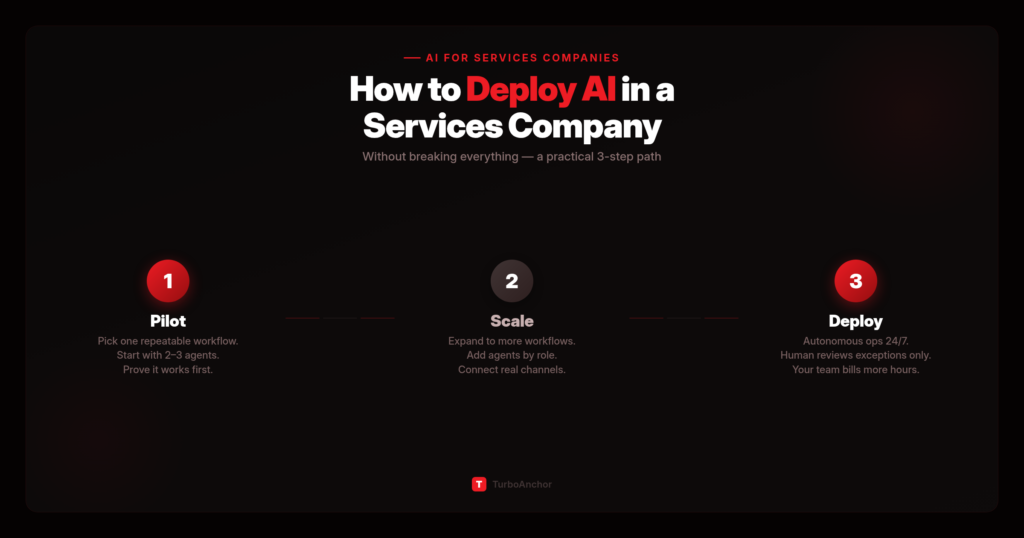
Services companies run on expertise. You bill for what your team knows and does. But between the client work, there’s a mountain of non-billable overhead — proposals, follow-ups, reporting, content, internal coordination. This is exactly the kind of work AI agent squads handle. Not by replacing your team. By handling the ops so your team focuses on the expertise you actually bill for.
Step 1: Map One Repeatable Workflow
Don’t try to automate everything at once. Pick one workflow that happens regularly, has clear steps, currently consumes billable team hours, and doesn’t require deep creative judgment every time. Good candidates: weekly client reports, content production, sales follow-ups, competitive research, internal task tracking. Pick one. Document what happens from trigger to completion.
Step 2: Define the Agent Roles for That Workflow
For content production, you might need a Research Agent, Content Agent, and Review Agent. For sales follow-up: a Sales Agent, Research Agent, and Ops Agent. Start with 2-3 agents. Don’t build a 10-agent squad on day one. Prove the workflow works first.
Step 3: Set Guardrails
Every agent needs boundaries. Draft-only mode for anything client-facing — the agent produces, human approves. Autonomous mode for trusted internal workflows. Channel restrictions: which platforms can each agent use? The rule: agents handling client communication start on draft-only. Move the slider as trust builds.
Step 4: Connect Your Channels
AI agents work where your team already works: Slack, Telegram, Discord, WhatsApp, and web chat. Connect the channels your team actually uses. If your team lives in Slack, start there. Don’t force anyone to adopt a new tool.
Step 5: Deploy, Measure, Iterate
Week 1: agents learn. Output will be rough. Review everything. Adjust instructions. Week 2: output improves. Less time on drafting, more on review. Month 1: at least one workflow is running with minimal human intervention. Time to add the next workflow.
How TurboAnchor Did It
We built Mission Control to run ourselves. Today, TurboAnchor’s operations run through it — Content Agent produces posts and social, Sales Agent manages outreach, Research Agent monitors markets, Operations Agent tracks deadlines, and the CEO Agent sets strategy. The same platform that runs our services company is available to yours.
What Not to Do
Don’t automate client relationships day one — start with internal workflows. Don’t build a 10-agent squad immediately — start with 2-3. Don’t skip guardrails — “draft-only” exists for a reason. Don’t expect perfection in week one — agents learn over time.
Start small. Scale fast.
Deploy your first agent free — prove a single workflow, then scale to a full squad.