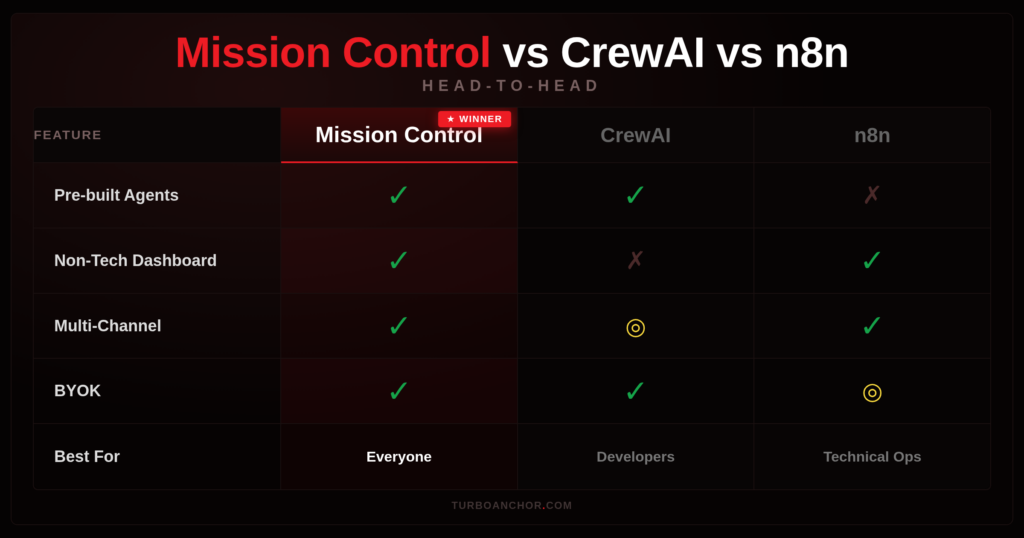
The AI agent platform space in 2026 is loud. Every vendor promises autonomous agents that “work while you sleep.” But when you strip away the marketing, three fundamentally different approaches have emerged — and they suit three very different kinds of buyers.
CrewAI is a Python framework for developers who want to code their agents. n8n is a visual automation platform that added AI agent nodes to its existing workflow engine. Mission Control is a full-stack business layer where non-technical operators deploy pre-configured agent squads through a dashboard.
This comparison isn’t about declaring a winner. It’s about matching the right tool to your team, your technical comfort level, and what you’re actually trying to build.
At a Glance
| CrewAI | n8n | Mission Control | |
|---|---|---|---|
| Category | Agent framework (code-first) | Workflow automation + AI nodes | Full-stack agent orchestration platform |
| Primary user | Python developers | Technical operators, automation engineers | Business operators, agency owners, non-developers |
| Interface | Python SDK + YAML | Visual drag-and-drop canvas | Web dashboard with kanban task board |
| Agent model | Code-defined roles + crews | AI nodes inside automation workflows | Pre-built role templates, user-defined roles |
| Multi-agent | Native (sequential, hierarchical) | Via chained AI nodes | Native (8+ pre-built agent templates, up to 16 agents) |
| Deployment | Self-hosted (OSS) or CrewAI Cloud | Self-hosted (free) or n8n Cloud | Self-hosted VPS or TurboAnchor-managed |
| BYOK | Required (you provide LLM API keys) | Required (you configure LLM credentials) | Built-in — core pricing model, zero markups |
| Paid plan from | $25/mo · 100 execs/mo | €24/mo · 2,500 execs/mo | From $19/mo (CX) / $69/mo (CPX) · 2–16 agents |
| Licensing | Open source (MIT) | Fair-code (Sustainable Use License) | Proprietary (built on OpenClaw Gateway) |
| White-label | Not offered | Not offered | Enterprise tier |
| Est. | 2023 | 2019 | 2025 |
Deployment: Where Your Agents Live
CrewAI — Bring Your Own Infrastructure
CrewAI’s core framework is open-source Python. You install it, write your agent definitions, and run them wherever you have Python and an internet connection. The framework itself is free; the hosted CrewAI Cloud adds a managed control plane with monitoring and team collaboration starting at $25/month for 100 executions.
The trade-off: you’re responsible for hosting, scaling, and monitoring the runtime. For a solo developer prototyping a research agent, this is fine. For a business trying to run a production squad of 5+ agents that coordinate on Slack, Telegram, and email — you’re building infrastructure, not deploying agents.
n8n — Self-Hosted or Cloud, Your Choice
n8n’s self-hosted Community Edition is free with unlimited workflow executions. Deploy it on a $5/month VPS and you’ve got a capable automation engine. The Cloud plans (€24–60/month) remove the ops burden but add execution limits — 2,500 to 10,000 executions per month.
The self-hosted model is n8n’s strength. But note: n8n’s AI agent capabilities are add-ons to a workflow automation platform. The agent is one node among many, not the organizing principle of the system. If your workflows are primarily data pipelines with occasional LLM calls, that’s perfect. If you want autonomous agents that manage their own task queues, reason across channels, and collaborate as a squad — you’re bending a workflow tool into an agent orchestration layer.
Mission Control — VPS Deployment, Zero Infrastructure Code
Mission Control deploys as a complete platform on your VPS (or TurboAnchor-managed infrastructure). No Python environments to configure, no Docker Compose to wrangle, no workflow nodes to wire. You pick a squad template (or define custom agents), connect your communication channels (Telegram, Slack, Discord, WhatsApp, Web Chat), and your agents are live.
The deployment model mirrors what businesses already understand: a SaaS dashboard, but one that runs on their own server. For teams that want the privacy of self-hosting without the engineering overhead, this distinction matters.
Agent Model: How the “Agents” Actually Work
This is where the three platforms diverge most sharply — and where the marketing gets loosest.
CrewAI: Agents as Python Objects
researcher = Agent(
    role="Senior Market Researcher",
    goal="Find recent product launches in AI",
    backstory="10 years covering data infrastructure.",
    tools=[search_tool]
)
In CrewAI, an agent is a Python object with a role, a goal, a backstory, and a set of tools. Tasks are assigned to agents, and a “crew” orchestrates them in sequence or hierarchy. It’s powerful, expressive, and entirely code. The agent’s “identity” lives in your prompt engineering, and its behavior is determined by the LLM you point it at, the tools you give it, and the process you define.
The upside: total control. The downside: no built-in communication channels, no message routing, no user-facing dashboard. Your agents exist inside your Python runtime. Making them accessible to a non-technical team member requires building a front-end.
n8n: Agents as Workflow Nodes
In n8n, an “AI Agent” is a node on a visual canvas. You configure it with a system prompt, connect it to tool nodes (HTTP requests, database queries, LLM calls), and wire its output to the next node — a Slack message, a Google Sheet update, an email.
This model shines when AI is one step in a larger automation. A support ticket arrives → AI agent classifies it → routes to the right team → posts a summary to Slack. The workflow is the product; the agent is a smart component inside it.
The limitation: n8n was not designed for autonomous, long-running agent squads. Agents don’t have persistent identities or task queues. Multi-agent coordination means chaining multiple AI nodes together and managing state manually. It works, but it’s not what the platform was built for.
Mission Control: Agents as Persistent Team Members
Mission Control’s agents are persistent entities with identities (name, role, avatar, skill set), communication channels, and a shared kanban task board. Each agent has a defined scope — CEO/Orchestrator, VP Sales, Content Writer, Research Analyst, VP Engineering — and they coordinate through the same task board your human team can see.
The key difference: Mission Control agents don’t live inside a single workflow or Python script. They’re always-on, always reachable through the channels your team already uses, and they manage their own task queues. A Content Writer agent doesn’t need to be “triggered” by a workflow node — it picks up assigned blog tasks from the kanban board and starts drafting.
This model is closer to hiring a remote team than to writing a Python script. The trade-off is that you don’t get the granular code-level control CrewAI provides, and you don’t get the 400+ connector library n8n offers. What you get is a squad that runs on the same dashboard that runs TurboAnchor’s own operations.
Pricing: What You Actually Pay
The pricing pages tell one story. Total cost of ownership tells another.
CrewAI
| OSS (Free) | Cloud Professional | |
|---|---|---|
| Platform cost | $0 | $25/mo |
| Executions | Unlimited (your infra) | 100/mo ($0.50/extra) |
| LLM costs | You pay API directly | You pay API directly |
| Hidden costs | Hosting, monitoring, scaling | Overages at $0.50/execution |
The open-source framework is genuinely free — but every agent execution burns LLM tokens on your API key. For a 5-agent squad running daily tasks, token costs can easily exceed the platform fee. CrewAI Cloud’s execution-based pricing also means costs scale with usage: more agents, more tasks, more money.
n8n
| Self-Hosted Community | Cloud Starter | |
|---|---|---|
| Platform cost | $0 | €24/mo |
| Executions | Unlimited | 2,500/mo |
| LLM costs | You pay API directly | You pay API directly |
| Hidden costs | VPS hosting ($3–7/mo), SSO/Git locked behind Business tier | Overages past 2,500 executions |
n8n’s self-hosted Community Edition is the most cost-effective option in this comparison — unlimited executions, free software, you just need a VPS. But the Community Edition lacks SSO, Git integration, and advanced audit features (all gated behind the €800/mo Business tier). For a small team running AI agents alongside traditional automations, this is hard to beat on price alone.
Mission Control
| CX Essential | CX Starter | CPX Pro | CPX Team | |
|---|---|---|---|---|
| Platform cost | $19/mo | $29/mo | $69/mo | $129/mo |
| Agents | 2 | 4 | 4 (+2 bonus US) | 8 (+3 bonus) |
| Channels | Web Chat | All (Telegram, Slack, Discord, WhatsApp) | All | All |
| LLM costs | BYOK — you pay API directly, zero markup | Same | Same | Same |
| Hidden costs | None | None | None | None |
Mission Control pricing is flat subscription based on hardware tier, not consumption-based. Agent limits scale with plan — 2 agents on Essential ($19/mo) up to 16 on Scale/Business. BYOK means you pay your LLM provider directly — Mission Control adds zero markup on API usage. The dogfood story isn’t just marketing: the same plans available to customers runs TurboAnchor’s own operations.
Total cost at 500 agent executions/month (with ~$75 in LLM API costs):
- Mission Control Pro: ~$144 (flat $69 + $75 API)
- CrewAI Cloud: ~$300 ($25 base + $200 overage at $0.50/exec + $75 API)
- n8n Cloud Starter: ~$99 (€24 base + $75 API, assuming within execution limit)
Flat-fee pricing isn’t just simpler to budget — at production scale, it’s meaningfully cheaper. CrewAI’s per-execution model means costs climb linearly with agent activity. n8n’s execution cap can surprise you when AI workflows run multiple nodes per trigger. Mission Control’s tiered model keeps costs predictable regardless of how hard your squad works — you pick the hardware and agent count that fits your scale.
BYOK and Privacy: Who Holds Your Keys?
AI agent platforms process sensitive business data. Where that data flows — and who controls the keys — matters.
CrewAI requires you to bring your own LLM keys. The framework never sees your API credentials; they live in your environment. When you use CrewAI Cloud, your execution data passes through their infrastructure, but LLM calls still use your keys.
n8n also requires you to configure LLM credentials. In self-hosted mode, everything stays on your server — workflows, data, keys. n8n Cloud processes workload on their infrastructure, which means your workflow configurations and execution data are in their environment (though LLM calls still route through your API keys).
Mission Control was built around BYOK as a core principle. Your API keys stay in your OpenClaw Gateway configuration — on your VPS. The platform never proxies your LLM traffic or logs your prompts. For businesses handling client data, legal documents, or proprietary workflows, this architecture eliminates the risk of a platform vendor having access to your AI conversations.
The practical difference: with CrewAI and n8n, BYOK is a configuration step. With Mission Control, BYOK is the business model.
The Dogfood Factor
Here’s something unique to Mission Control: the platform you’re evaluating is the same platform running the company that built it.
TurboAnchor’s own operations — content production, sales outreach, market research, development coordination — all run through Mission Control agents on the same Pro plan available to customers. Every feature ships because the internal team needed it. Every workflow template exists because the company dogfooded it first.
CrewAI’s team certainly uses CrewAI internally. n8n certainly automates parts of their business. But neither makes their internal setup visible to customers as a proof point. When TurboAnchor demos Mission Control, they show the real dashboard — not a sandbox, not a mockup. The CEO/Orchestrator agent, the Content Writer agent, the Sales agent, the Research agent are all active in production.
This matters because AI agent platforms are still young. The gap between “works in a demo” and “works in production” is wide. A vendor that depends on its own product for daily operations has a different relationship with reliability than one that doesn’t.
Which One Fits Your Business?
Choose CrewAI if:
- You’re a Python developer or have one on your team
- You want total control over agent behavior, prompts, and tooling
- You’re building a custom AI product where agents are the core IP
- You don’t need a user-facing dashboard or non-technical operator workflow
- You’re comfortable managing your own deployment, monitoring, and scaling
Bottom line: CrewAI is a framework for building AI agents. It’s not a platform for running a business on them.
Choose n8n if:
- Your primary need is workflow automation, and AI is one component
- You already use n8n (or Zapier/Make) and want to add AI capabilities
- You need 400+ native app connectors (CRMs, databases, email, APIs)
- You’re comfortable with visual, node-based workflow design
- Your AI use cases fit into triggered workflows rather than autonomous squads
Bottom line: n8n is a workflow automation platform with strong AI agent nodes. It’s excellent when AI is a step in a broader automation — not when AI is the operating system.
Choose Mission Control if:
- You want to deploy an AI squad without writing Python or wiring workflow nodes
- You need agents that communicate through the channels your team already uses (Slack, Telegram, Discord, WhatsApp)
- BYOK and data privacy are non-negotiable
- You want to see your agents’ work in a shared kanban board, not a terminal
- You’re running a business (agency, e-commerce, services) and want AI to handle operations, not just automations
- You value a platform that dogfoods its own product in visible, demonstrable ways
Bottom line: Mission Control is a platform for running a business on AI agents — not a framework, not a workflow tool. If you’d rather deploy a squad than build one, this is your category.
The Honest Truth
None of these platforms is “better” in absolute terms. They’re solving different problems for different people:
- CrewAI solves the developer problem: “I want to code a multi-agent system exactly the way I want it.”
- n8n solves the automation problem: “I have business workflows that would benefit from AI-powered steps.”
- Mission Control solves the operations problem: “I want AI agents to run parts of my business the way a human team would — with roles, tasks, channels, and a dashboard I can actually use.”
The right question isn’t “which platform is best?” It’s “what are you trying to run?”
- If you’re building a custom AI product → CrewAI.
- If you’re automating business processes with an AI boost → n8n.
- If you’re deploying an AI workforce to run business operations → Mission Control.
Book a demo to see the real Mission Control dashboard — the same one that runs TurboAnchor’s own operations.
TurboAnchor is the company behind Mission Control — a multi-agent AI platform that coordinates sales, marketing, content, development, and operations. The same system that runs TurboAnchor, now available to businesses. BYOK. Plans from $19/mo. Start free.