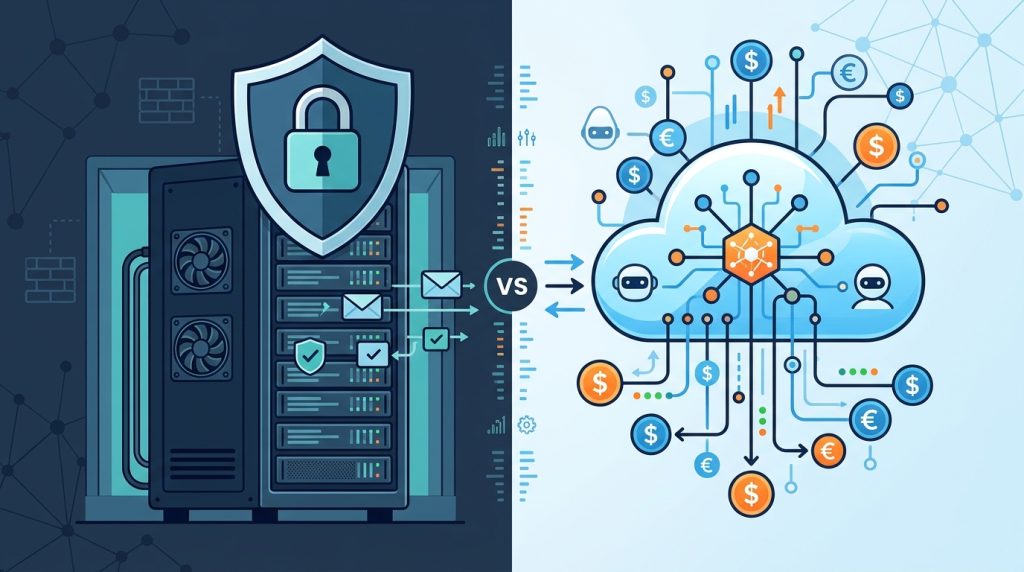
When a business starts deploying AI agents, the first fork in the road isn’t which agents to build — it’s where they run. Self-hosted or cloud. And that single decision quietly determines three things for the next several years: what you pay, who can see your data, and how much control you actually have.
This is the complete breakdown: cost, privacy, BYOK, and the trade-offs most vendors won’t spell out.
What the two models actually mean
Cloud AI agents run on the vendor’s infrastructure. You log into a dashboard, configure your agents, and the vendor handles hosting, scaling, and maintenance. You pay a subscription — and usually a markup on the AI usage your agents consume.
Self-hosted AI agents run on infrastructure you control — a VPS, a bare-metal server, or an on-premises machine. The software is installed in your environment, your data stays in your environment, and you bring your own LLM keys (BYOK). You pay for hosting and API usage directly, with no AI markup.
Both models are legitimate. They solve different problems. The mistake is picking one without knowing what it costs or what it exposes.
Cost: the number on the pricing page is not the number you pay
Cloud pricing looks simple. A monthly fee per seat, per agent, or per execution. But AI agents are consumption machines — every task, every research pass, every drafted reply burns tokens. The moment your squad scales, the real cost is the usage markup baked into the platform, not the subscription line.
Three costs that hide in cloud AI agents:
- Usage markups. Many cloud platforms resell LLM access at a premium — sometimes 2× to 10× the raw API price. You pay the platform, the platform pays the model provider, and the spread is theirs.
- Per-agent or per-execution fees. A “cheap” cloud plan often caps agent count or executions. Add three more agents or a heavier workload and the bill climbs linearly.
- Data egress and overages. Exporting your history, logs, or memory when you want to leave can come with its own fees — assuming the vendor lets you take it at all.
Self-hosting flips this. You pay:
- Hosting — a $5–$40/month VPS is enough for most agent squads.
- Raw LLM API costs — exactly what the model provider charges, because BYOK means you hold the key and pay the provider directly.
- Zero platform markup — the platform doesn’t tax your AI usage.
The trade-off is real but different: with self-hosting, you own the ops burden — updates, uptime, and backups. That’s not free. But it’s a fixed, knowable cost, not a variable one that scales with how hard your agents work.
Privacy: the question most buyers skip
Every AI agent touches sensitive data. Customer conversations. Internal documents. Pricing. Strategy. Where that data lives — and who else can see it — is a compliance question as much as a technical one.
Cloud agents route your data through someone else’s servers. For a marketing task, that’s low-stakes. For client legal documents, healthcare records, financial data, or proprietary workflows, it’s a different conversation. You’re trusting the vendor’s security posture, their retention policies, and their subcontractors.
Self-hosted agents keep data in your environment. Your prompts, your memory, your agent conversations never leave your server. The only external call is the one to your own LLM provider — and with BYOK, that’s a relationship you already control.
The privacy difference isn’t binary — cloud vendors vary widely in their security — but the default posture is fundamentally different. Self-hosting starts closed. Cloud starts shared.
BYOK: the pricing model that changes everything
Bring Your Own Key is the single most important differentiator in this decision, because it collapses cost and privacy into one choice.
With true BYOK:
- You input your own LLM API keys (OpenAI, Anthropic, Google, or a self-hosted model like Llama).
- The platform routes your agents’ calls to your provider account.
- You pay the provider directly, at cost.
- The platform never holds, proxies, or logs your prompts.
This means your AI costs are transparent by default. You see exactly what the model charges you. There’s no black-box “usage fee” line item to audit.
The catch: BYOK only delivers its full privacy benefit when paired with self-hosting. A cloud platform that asks for BYOK keys still hosts the orchestration layer — your agent configs and possibly your prompts — on its servers. Self-hosted BYOK keeps both the keys and the data under your control.
Control: who has the kill switch
Self-hosting means you own the deployment. You decide when to update, when to scale, when to migrate. You’re not at the mercy of a vendor’s roadmap, a surprise pricing change, or a product that gets acquired and sunset.
The honest cost of that control is responsibility. Someone on your team needs to handle the server, apply updates, and manage backups. That’s a real skill — though with modern managed platforms, it’s mostly “pick a VPS and follow the setup steps,” not “run a datacenter.”
Cloud means the vendor carries that load. You trade control for convenience. For fast-moving teams without infrastructure expertise, that’s often the right call early on. The risk is that the convenience becomes a dependency — and switching later means rebuilding your agents from scratch.
A practical decision framework
Choose cloud AI agents when:
- You need to be live today with zero infrastructure work.
- Your use cases are low-sensitivity (marketing, social, general drafting).
- You have no one to handle a server, and no appetite to learn.
- You accept operating margin as a cost of convenience.
Choose self-hosted AI agents when:
- Your data is sensitive — clients, legal, financial, healthcare, proprietary workflows.
- You want predictable costs that don’t scale with agent activity.
- BYOK is non-negotiable and you want zero usage markup.
- You need white-label or fully controlled environments.
- You’re running agents that touch real business operations, not just content drafts.
Why TurboAnchor built Mission Control around self-hosted BYOK
Mission Control is a multi-agent AI orchestration platform, and its deployment model answers this exact question. It’s self-hosted by default — deploy on your own VPS or TurboAnchor-managed infrastructure — and BYOK is the pricing model, not an add-on.
That means:
- Unlimited agents on paid plans — no per-agent fees, no execution caps.
- Zero usage markup — you hold your LLM keys and pay your provider directly.
- Your data stays yours — prompts, memory, and agent conversations live on your server.
- A real dashboard, not a sandbox — the same platform runs TurboAnchor’s own operations.
We built it this way because we run our own company on Mission Control every day. When your AI workforce handles your sales pipeline, your content, and your operations, you don’t want a monthly surprise on the usage bill or your data living on someone else’s servers. You want control.
The bottom line
Self-hosted vs cloud AI agents isn’t a contest with a universal winner. Cloud wins on speed and convenience. Self-hosted wins on cost transparency, privacy, and long-term control.
The right question isn’t “which is better?” It’s “what am I running, and who needs to see it?”
If your agents are drafting marketing copy, cloud is fine. If they’re touching client data, legal documents, or the operational core of your business — self-hosted BYOK is the decision that scales without regret.
Book a demo to see the real Mission Control dashboard — the same one that runs TurboAnchor’s own operations. Start free with one agent.
TurboAnchor is the company behind Mission Control — a multi-agent AI platform that coordinates sales, marketing, content, development, and operations. The same system that runs TurboAnchor, now available to businesses. BYOK. Unlimited agents. Start free.