Digital Marketing
AI Marketing Agents: What They Can Actually Do for SEO, Content, and Lead Generation
Posted on: May 31, 2026 11:48 PM

AI marketing agents are becoming one of the most talked-about parts of modern marketing automation. Some people describe them like full-time digital employees. Others treat them like a smarter version of a chatbot.
The practical truth is somewhere in the middle.
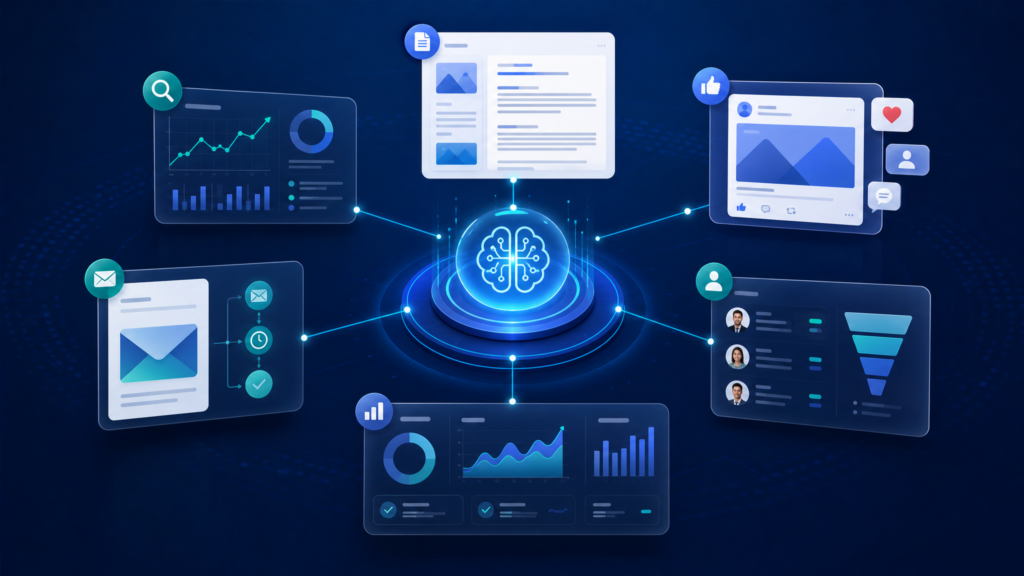
An AI marketing agent is not a magic button that replaces your marketing team. It is a task-focused system that can research, write, organize, optimize, report, and trigger follow-up actions when it is connected to the right tools and guided by the right strategy.
For small and mid-sized businesses, that distinction matters. The goal is not to remove human judgment from marketing. The goal is to reduce repetitive work, speed up execution, and give your team more time to focus on positioning, offers, relationships, and growth.
Here is what AI marketing agents can actually do for SEO, content, and lead generation — and where human expertise still matters.
An AI marketing agent is software that uses AI to complete marketing tasks with a defined goal. Unlike a basic AI prompt, an agent can usually follow a workflow, use stored instructions, work with business data, and connect with tools such as a CRM, website, email platform, analytics dashboard, or content calendar.
For example, a simple AI prompt might write one blog outline.
An AI marketing agent could:
That is where AI agents become useful. They are not just answering questions. They are helping move marketing work from idea to execution.
SEO usually starts with questions:
AI marketing agents can help by organizing keyword ideas, clustering topics, comparing search intent, and turning broad service areas into focused content plans.
For example, a business that offers digital marketing services might start with a broad topic like “SEO.” An AI marketing agent can help break that into practical content themes such as local SEO, AI search visibility, content optimization, technical SEO, and lead generation pages.
This is especially useful for businesses that know they need content but do not have a clear publishing system. The agent can turn scattered ideas into a weekly or monthly content calendar.
Human review is still important. Keyword tools and AI suggestions can identify opportunities, but your team should decide which topics match your offers, sales priorities, and audience.
AI marketing agents can create strong first drafts when they are given a clear brief, audience, tone, and service context.
They can help prepare:
This is where many businesses see an immediate productivity gain. Instead of starting from a blank page, the team starts with a structured draft that can be edited, improved, and approved.
The best use of AI content is not “publish whatever the AI writes.” The best use is to accelerate the first 60 percent of the work so human marketers can spend more time on the final 40 percent: examples, accuracy, brand voice, proof, and conversion.
For SEO, that human layer matters. Search engines and readers both reward content that is useful, specific, and trustworthy. A generic AI article will not build authority. A practical article shaped by real business knowledge can.
AI marketing agents can also support on-page SEO and Answer Engine Optimization, or AEO.
They can review a draft and suggest improvements such as:
This matters because search is changing. Customers are no longer only typing keywords into search engines and clicking the first blue link. They are also using AI assistants, answer engines, voice search, and search results that summarize information directly.
Content now needs to answer real questions clearly.
An AI marketing agent can help turn a standard article into a more useful resource by adding direct answers, practical examples, and clear next steps. That makes the content easier for both readers and search systems to understand.
Most businesses do not need more random social posts. They need a system for turning useful content into repeatable distribution.
AI marketing agents can take one approved article, webinar, case study, or service page and turn it into multiple assets:
This saves time because the core idea only has to be developed once. The agent then adapts it for different channels.
For example, a blog post about AI marketing agents could become a LinkedIn post for founders, an email for warm leads, a short video script for marketing teams, and a sales follow-up message for prospects asking about automation.
The key is consistency. AI can help produce variations, but your team should still approve the final message before it goes public.
Marketing is not only about traffic. It is about creating conversations with the right potential customers.
AI marketing agents can support lead generation by helping with:
For example, when someone fills out a form asking about SEO or marketing automation, an AI agent can ask follow-up questions, identify the service area, summarize the lead, and notify the right person.
That helps sales teams respond faster and with better context.
However, businesses should be careful with fully automated sales conversations. High-value leads still need human judgment, empathy, and relationship-building. AI is best used to speed up intake, reduce missed follow-ups, and prepare the sales team.
One of the most practical uses of AI marketing agents is reporting.
Many marketing teams have access to data but not enough time to review it properly. An AI agent can help summarize:
Instead of asking a team member to manually prepare the same report every week, the agent can generate a first version with highlights, warnings, and questions.
For example:
These insights help marketing managers make faster decisions.
The agent should not replace analysis completely. Data needs context. But it can make reporting faster, more consistent, and easier to act on.
A lot of lead generation is lost after the first touch.
A prospect downloads a guide, submits a form, asks about pricing, or attends a call — and then the follow-up is delayed or forgotten.
AI marketing agents can help create and manage follow-up workflows such as:
This is valuable for service businesses because speed and consistency often affect conversion. If your team responds faster, with better context, you have a better chance of turning interest into a real sales conversation.
The safest setup is usually human-approved automation. The AI can draft or trigger routine follow-ups, while sensitive messages, pricing, contracts, and strategic replies remain under human control.
AI marketing agents are useful, but they need boundaries.
They should not independently make decisions about:
A good AI marketing workflow includes review points. That protects the business and improves quality.
The strongest results come when AI handles repetitive execution and humans handle judgment.
A small business does not need to automate everything at once. A better approach is to start with one high-friction workflow.
Here is a simple example:
Monday: Topic research The AI agent reviews service priorities, keyword ideas, and existing content gaps.
Tuesday: Content brief The agent creates a blog outline, target keyword, suggested internal links, and FAQ ideas.
Wednesday: Draft and SEO review The agent prepares a first draft and checks it for title, headings, meta description, search intent, and readability.
Thursday: Human approval and distribution A marketer reviews the final article, adds examples, approves the message, and publishes when ready.
Friday: Lead and performance summary The agent summarizes traffic, inquiries, form submissions, and follow-up tasks.
This is not futuristic. It is a realistic way to make marketing execution more consistent without hiring a large team.
There are three common ways to adopt AI marketing agents.
1. Use ready-made tools This works for simple content, scheduling, reporting, or chatbot workflows. It is fast, but may not match your exact process.
2. Build custom automation This works when your workflow depends on your CRM, website, sales process, data, or internal approvals. It takes more planning but can create a better long-term system.
3. Hire trained remote marketing and automation talent This works when you need people who can operate the tools, review the output, improve campaigns, and manage execution every week.
Most businesses need a mix. Software alone is rarely enough. A skilled team without automation may be too slow. The best setup combines trained people, clear processes, and AI agents that handle repeatable work.
TurboAnchor helps businesses use AI automation and trained remote talent to improve sales, marketing, and operations.
For marketing teams, that can include:
The goal is practical implementation, not hype. TurboAnchor starts by understanding the business process, then recommends the right mix of automation, remote talent, and ongoing optimization.
AI marketing agents can help businesses move faster, publish more consistently, follow up with leads, and understand campaign performance.
But they work best when they are connected to a clear strategy.
If your marketing team is spending too much time on repetitive research, drafts, reports, and follow-ups, AI automation can help. Start with one workflow, define the outcome, keep human review in place, and improve the system over time.
Ready to see where AI can reduce manual marketing work in your business? Book a strategy call with TurboAnchor for AI-powered marketing automation.